
Organizations are navigating an unprecedented level of complexity and challenge as they seek to gain more applied innovation and value from their technology investments. In recent years, the advent of AI and all-things digital has enabled vastly improved capabilities spanning decision making, operations surveillance, monitoring and alerting, workflow optimization, and more. And yet, there will always be more technology (and the demand for it) than what organizations will commit to implementing and adopting.
Expectations are higher than ever for today’s technology leaders to ensure effective governance, adoption, and support of this ever-expanding technology portfolio. Alignment of investments with what truly matters to the organization remains paramount if increasingly difficult. In parallel, a growing base of embedded infrastructure, systems, and support services must also be cost-effectively maintained. And the pace at which things must be evaluated, implemented, and managed is accelerating as the availability of solutions grows. Combined, these expectations, needs, and market forces require enhanced levels of technology leadership and performance.
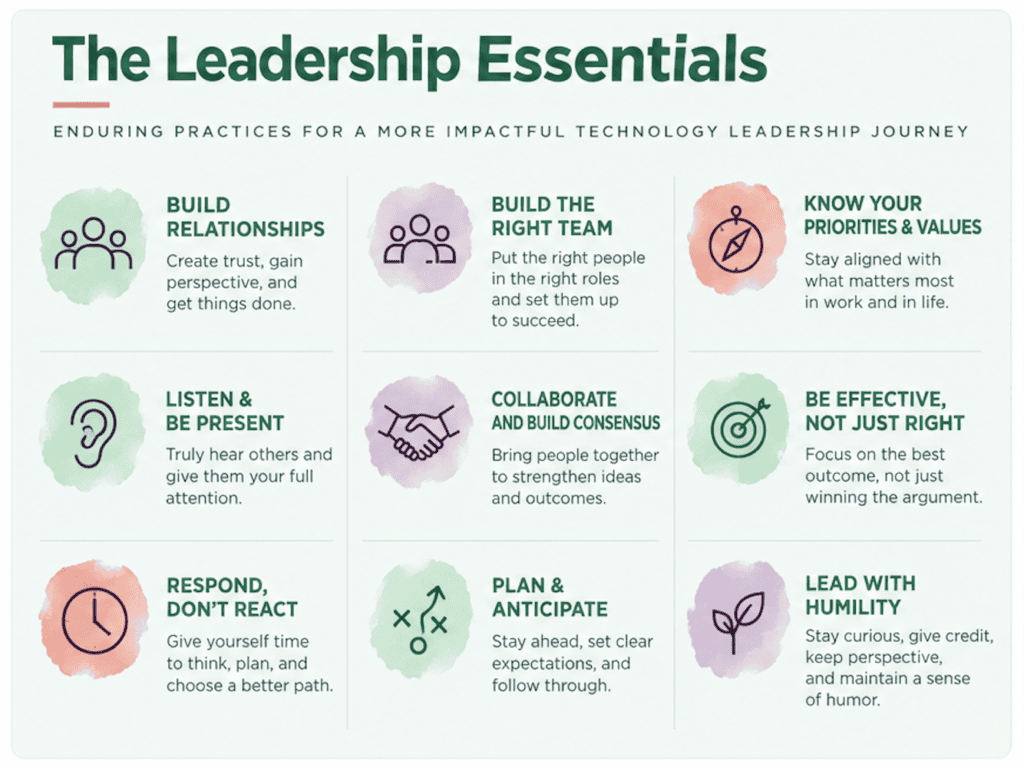
As a former and long-tenured health system CIO, I’ve experienced firsthand multiple periods and phases of technology change over 45 years. As my career progressed, I learned to value and apply a few leadership essentials that served me well. I offer these in the hope that they may in some way be of help to you in your career.
Develop and maintain a variety of relationships
Relationships are vital to one’s well-being, their sense of belonging, and overall success. Different types and levels of relationships help one to develop and mature into a well-rounded, respected and collaborative leader. As in all of life, relationships are the bedrock of building and maintaining trust. A leader who values relationships regularly seeks engagement and collaboration with others. Furthermore, strong and lasting relationships are a catalyst to informed decision making and to getting things done.
Check-up: Think about your relationships and how they could be improved. Do you need to invest more time and effort into certain individuals? Do you need to establish new relationships? Do you have negative relationships that need mending – or ending?
Build your team with the right people
Leaders can demonstrate all the requisite skills of their role only to be let down by a failure on the part of their team to deliver and perform. Thus, the leader also fails. This unfortunate reality can quickly erode the leader’s personal brand, and, if not corrected, lead to the removal from their role. Leaders must effectively get things done through their teams. Be it the day-to-day break fix, managing operations, or working the more strategic and/or innovative endeavors. There simply is no substitute for having the right team members in the right roles, ensuring they are appropriately compensated and given the opportunity to achieve their potential.
Check-up: Are your teams performing at the level expected? Do you have under-performing team members who need help with training, mentoring or coaching? Do they need to be reassigned to another role? Or should they be removed from the team? Are your team members appropriately compensated? Act quickly and decisively should anything need to be addressed.[CR1]
Know and honor your life’s priorities and values
Most would agree that knowing and honoring one’s life priorities and values is of vital importance, spanning personal and professional pursuits. When career demands create conflict with life’s priorities and values, a level of discontent, frustration and/or confusion often ensues. If not addressed, this can lead to damaged relationships, a loss of personal well-being and ultimately career and/or life failures. Honoring one’s life priorities and values will contribute greatly to achieving the all-important work/life balance.
Check-up: Make the effort to evaluate where you invest your time, money, and thoughts. Are they aligned with your life priorities and values? If not, consider making the appropriate changes. Achieve harmony and balance in life and work.
Seek first to listen. And always be present
Many leaders confuse listening with waiting to talk. Real listening is hard work that requires a commitment to hear and understand what others are communicating. Effective listening demands one’s full attention and presence. Pretending to be listening and/or present is a common mistake of busy leaders. Doing so sends a message of disrespect and lack of interest. Technology has surely exacerbated this temptation: smartphones, earbuds, and laptops can render a person mentally completely absent while still being physically present. Eye contact and body language matter. Those who demonstrate active listening are respected and valued by others.
Check-up: Ask a trusted colleague to give you feedback regarding your listening habits. Ask them to be honest and to “catch you in the moment” when you are listening and present and when you are not. You may need to break old habits.
Collaborate and build consensus around what is important
Open and honest collaboration is of paramount importance, leading to strengthened relationships and consensus on what matters. Collaboration, like brick mortar, holds things together while strengthening the overall structure. Technology leaders, especially, must participate in strategic discussions and planning as well as demonstrate their understanding of the organization’s priorities through effective collaboration and communication. The technology leader’s own plans and priorities must, of course, align with those of the business and needs of other executives, with clarity of purpose in what is driving investments, budgets, and staffing.
Check-up: Do you and your teams effectively collaborate? Why or why not? What skills and abilities do you use to ensure collaboration within your areas of responsibility as well as across the organization? What collaboration actions do you need to begin or continue?
Manage expectations and follow-up
Few lapses in performance will drive the technology leader out of their role quicker than failing to effectively set and manage expectations. When interactions with others involve some level of expectation management, it is essential to have clarity and consensus on the specifics, which must then be managed appropriately to ensure everyone remains informed and updated on status and progress. Expectations should also be changed or reset if necessary to drive successful outcomes. One’s follow-up practices also have much to do with how others perceive their leadership ability and performance. Granted, the technology leader has an increased challenge given the ubiquitous availability of, and demand for, solutions and services. Yet, that is and always has been the nature of the role.
Check-up: Have you surprised others with status updates or outcomes that they were not expecting? Do your colleagues ever express uncertainly as to the purpose and/or delivery of your commitments, plans and priorities? What process or practices do you use to ensure timely follow-up on your commitments? What might you need to change or improve?
Seek first to be effective, rather than right.
Achieving the goals and objectives of teams and organizations requires effective leaders who deliver results while building confidence, strengthening relationships, and moving things forward. Being effective diffuses conflict, builds trust, drives good decision making, and promotes collaboration. Effective leaders listen to others, encourage new ideas, and seek solutions rather than personal convictions or validations. The desire to prove one’s viewpoint as correct or the best may at times seem appropriate, especially under stressful conditions. However, doing so can easily erode leadership effectiveness. Leaders should always be aware of their intentions and choose wisely to enable success rather than to prove a point, dictate a plan of action, or push for a predetermined outcome.
Check-up: At this stage of your leadership development, which do you enjoy the most – being effective or being right? Do you lead and contribute in ways that encourage others to engage fully and contribute their ideas and perspectives? How often do you insist on making your point or push others to see things your way? What would your teams and colleagues say?
Prefer to respond vs react
Unexpected challenges outside of one’s control arise every day. There is usually an “in the moment” choice to be made: react or respond. Many relationships and careers have been damaged because of one’s reaction where a considered response would have been more effective. The difference between the two is the element of time – time to think, time to cool off, time to plan or reflect before responding. Outside of certain vocations where individuals are trained to appropriately immediately react to conditions or situations, responding usually leads to a much more favorable outcome.
Check-up: Reflect on past situations that have occurred in your personal and/or professional life when something happened that you were not expecting or was out of your control. How did you handle it? Did you react or respond? Challenge yourself to always seek to respond if at all possible.
Proactively plan and anticipate
Well-performing teams and organizations collaboratively plan and anticipate demands, challenges, needs, and opportunities. Enabling an organization through technology requires close alignment with business strategy and priorities. Technology leaders must plan and account for the unexpected as well as those things that might happen and those that should. Contingency plans are a critical component. Naturally, plans and priorities change along with the occurrence of unexpected events and situations. As such, planning should be an ongoing process. Effective planning (and execution) results in the ability to meet these challenges and keep moving forward.
Check-up: Review your planning process as well as current progress and status. Is it aligned with your organization’s priorities? Is it ongoing? Does it account for any necessary contingencies? Ensure your executive colleagues and team members collaboratively contribute, understand, and support what is planned and how plans are maintained and updated.
Maintain a sense of humor and humility
Leadership is a continuous process of growth and maturing through experiences. Mistakes are made, lessons are learned and, along the way, some success occurs. Wherever one is along their career’s path, leadership is a demanding role that requires continuous development. The leader is always on stage and is always the example others will see and choose to follow (or not). Through it all, the leader who remains humble and keeps their sense of humor will likely find more success than those who don’t. Leadership at any level is a serious undertaking, but staying humble and injecting a bit of levity along the way can make a remarkable difference.
Check-up: Look for opportunities to bring appropriate humor into relationships and situations. Be humbled and thankful for the leadership opportunity you have been given. Be quick to recognize the work and accomplishments of others. Give the credit. Take responsibility. Is there someone you know and respect who admirably demonstrates humility and a sense of humor? Think about what you may be able to learn and apply from their demeanor.
In conclusion:
Technology will continue to change, and the expectations of those who lead it will evolve just as quickly. Yet the essentials of effective leadership remain remarkably steady: cultivate relationships, stay grounded in your values, listen well, collaborate, plan thoughtfully, build strong teams, and respond with intention. The leaders who practice these habits with consistency, humility, and a little humor will be best prepared not only to guide their organizations through what comes next, but to make the journey meaningful for themselves and the people alongside them