
Future of Work: 2026
Future of Work, Insights
An Introduction.
The Future of Work 2026, informed by survey responses collected in November and December of 2025, observed a broadly stable healthcare talent ecosystem. Some of the uncertainty reported last year seems to have subsided. Respondents, 89% of whom were healthcare board members, C-suite executives, or managers, highlighted a renewed commitment to evergreen imperatives, such as revenue growth, while responding to newly budded challenges, including unpredictable regulatory changes.
As highlighted in our analysis, AI is undoubtedly here, and many respondents think it has the potential to change pretty much everything about the way we work. How exactly AI will drive that change, however, remains widely unclear.
Adaptability: The Key to Workforce Success.
When considering which workforce attributes will be most crucial for organizational success, healthcare board members, C-suite executives, and managers roundly observed one hallmark distinction: adaptability.
To succeed today, adaptability … is crucial.”
Financial literacy and “technical acceptance” had their fair share of mentions, as did softer characteristics, such as “patience,” “vulnerability,” “empathy,” and “integrity.” Communication, analysis, and strategy, together with “collaboration” and “listening” were also described as vital.
Still, “adaptability” and an “ability to pivot” were by far the most quoted characteristics. This shouldn’t be too surprising a finding, given industry and regulatory fluidity. Still, the specificity of the response is striking in its near universality.
Priorities When Considering New Roles
A notable shift from last year was how respondents ranked what was most important to them personally when considering a new role. Last year, compensation topped the list for the first time, but this year.
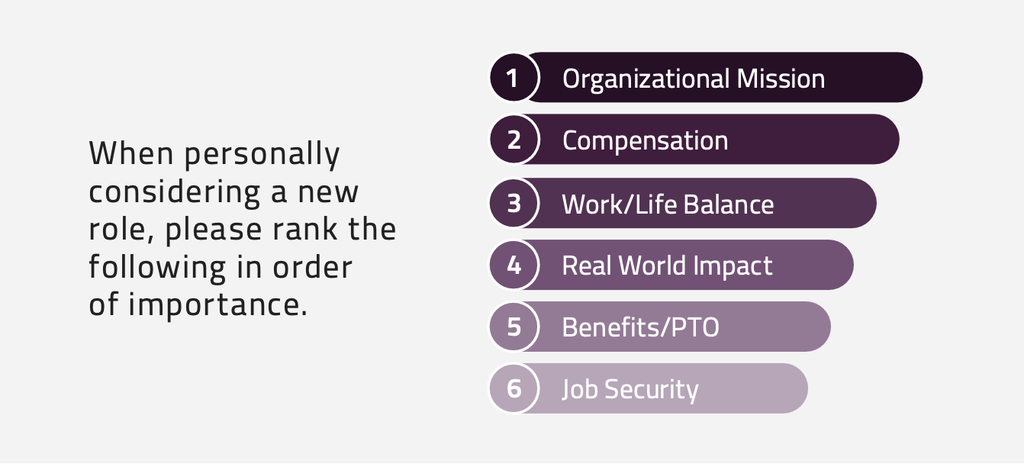
it fell back down to second place, behind organizational mission. This ranking is a return to the results of two years ago. The disparity might be more reflective of the economic uncertainty when last year’s survey was conducted (November-December 2024), whereas a year later, the economic situation appears at least temporarily stable, if still fluctuating.